01
Analytics
What your operation handles now, and where it will stop coping as you grow.
Consulting & advisory
Logistics/Supply Chain/AI/Robotisation
I take a project from the first rough sketch to a system that runs.
The same work for a first warehouse as for a national network. Smaller companies often assume that’s beyond them. It isn’t.
What your operation handles now, and where it will stop coping as you grow.
Where the trouble actually sits in your existing operation — often a quick, cheap fix, not the big project you were bracing for.
The warehouse interior — processes, flow of goods, zoning, and the handling equipment that moves everything.
Where stock sits and how it moves between sites, so the chain holds under load.
From the goods outward: storage, support, a building wrapped around them, then the site. Tight plots push back, and earlier choices get revised.
The design run as a simulation under real demand — you see how it behaves before you commit.
Robots and automation where they pay for themselves, scoped to the operation they serve — and left out where they don’t.
Seminars for senior teams on what AI and simulation really change, worked through real warehouse cases.
A mathematician who builds the places goods move through — and likes to talk to the people who run them.
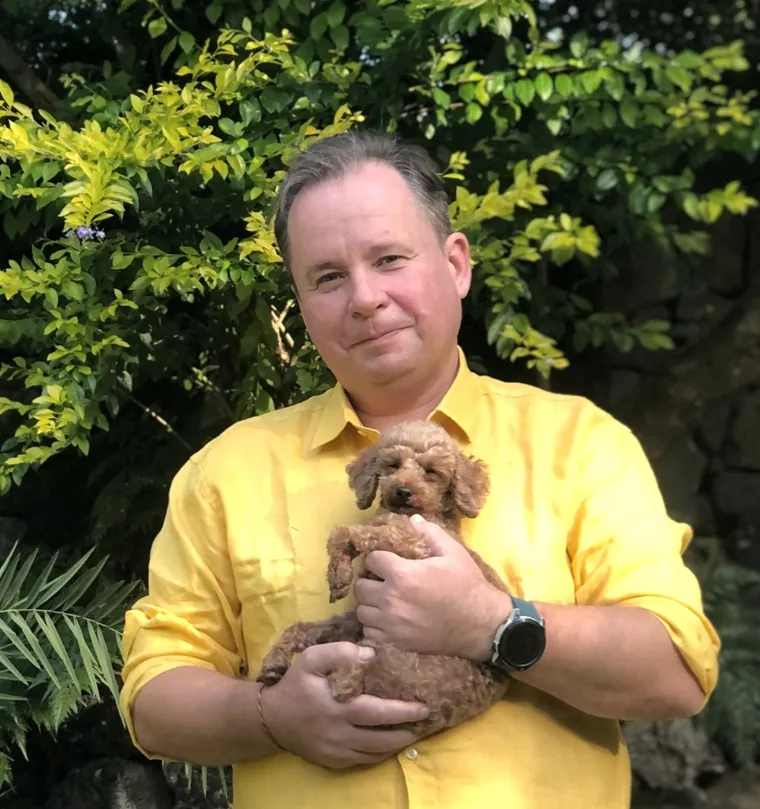
Started with mathematics and computer sciences at Moscow State University, 30 years back. 25 years in logistics and IT followed — 15 of them running the Moscow branch of a German engineering firm — building warehouses, factories, and distribution networks across Europe, Turkey, China, and broader Asia, often in places that hadn’t seen anything like them before. Schneider Electric, Bosch, BMW, Unilever, and Nestlé among the clients.
5 years ago AI and simulation became my working tools. 4 years ago the practice moved to Mauritius. It runs from here now — sometimes at a desk, sometimes elsewhere, occasionally paused for a game of chess. 2 dogs underfoot, one cat squarely on the board.
Every step stands on its own — you get something usable at each one, not just at the end.
It starts with an operation hitting a limit. I walk the site and talk to the people who run it — and almost always there’s something to put right that doesn’t have to wait for the big project.
Then we model the flows and size them — whether your space, equipment and staffing will carry the demand ahead. You keep the math, to run again whenever you need it, without me.
Then how goods move and what moves them — automation, a better process, or lately a small AI model that does what you’d otherwise pay for in people or robots. The answer often surprises us both.
When it gets complex, a drawing won’t convince anyone — so we simulate it. You watch it run under real demand, and decide once you’ve seen it move.
None of this happens from a distance — I’m in it with you the whole way, trading what I’ve seen for what you know. Sometimes the idea that wins is yours.
Three projects. The number first — open one and I’ll tell you how it got there.
Finding a given item was almost impossible; people were burning hours hunting for stock. It looked like an efficiency problem, but it wasn’t — it was a customer one. Every order we couldn’t fill on time was a sale walking out the door.
So I started with data, before any racking or robots: we rebuilt the item master, so the warehouse actually knew what it held, then sorted the packaging product by product. Get that layer wrong and everything downstream inherits the mess. From there the sizing — how many locations, on shelves and in racking, for the demand ahead — then the processes, written out, and the people they’d need.
What changedWe ran the supplier tender and stayed through the build. I didn’t leave until the new warehouse was running.
I walked it and mapped the processes. Pick slots were being topped up carton by carton — the operator climbing down to move boxes by hand, then lifting the pallet back into the racking.
My suggestion was simple: replenish with full pallets instead. The objection was fair — rotation, swapping stock around the pick face, slow and costly. So we settled it with numbers. A process model built on standard times put the full-pallet method at three times more efficient, even counting the extra return flow.
What changedThey put it in and handled more volume than before — without buying a single extra reach truck.
We mapped the processes together, wrote the requirements, and picked a modest system with just enough in it — then put two small AI models on top.
The first placed stock by where demand was heading: fast movers near the dispatch doors, slow ones deep in the back — sharper than the usual ABC analysis. The second handed pickers their orders so they walked less, grouping the picks to cut wasted steps — sometimes pulling three orders out of one aisle in a single pass.
What changedPicking productivity doubled. No drawn-out rollout, no clever algorithm that goes stale the week the flow shifts.
A few of the people I’ve built for.
A reliable partner in logistics design and engineering consulting.
Excellent team, goals clear from day one, results we could put straight to work — we brought them back for the next project.
The conversation is the part I like best — it’s how I keep learning, too.
Write in whatever language you think in. Happy to talk a problem through with you — whether or not it ever becomes a project.
In motion